Mastering l'optimisation de WordPress pour la découverte d'IA
Vous vous souvenez quand la recherche consistait à saisir une requête et à parcourir une liste de liens bleus ? Ces jours sont révolus. D’ici 2026, environ deux recherches sur trois aux États-Unis et au Canada ne mènent pas à l’ouverture d’un site web. Le chercheur trouve sa réponse directement sur Google – souvent grâce à un résumé d’AI ou à un extrait présenté – ou il contourne Google tout simplement et demande à ChatGPT, Gemini ou Perplexity. Pour les propriétaires d’entreprise comptant sur le trafic organique pour générer des leads, ce changement semble comme un mouvement de terre sous leurs pieds.
Nous travaillons avec des petites et moyennes entreprises au Canada et aux États-Unis qui constatent que leur visibilité dans les résultats de recherche, qu’ils ont si durement gagnée, s’est éteinte à mesure que des réponses générées par l’IA prennent le dessus sur la page des résultats. La question la plus souvent posée aujourd’hui n’est pas “ comment améliorer notre classement ? ” mais “ comment même être vu quand personne plus ne clique ? ” La réponse réside dans une nouvelle forme d’optimisation : rendre votre site WordPress lisible, accessible et fiable pour les systèmes d’IA qui sont désormais les gardiens de la découverte en ligne.
Table des matières

Pourquoi la recherche sans clic remodèle les attentes en matière de trafic
Commencons par les chiffres. Recents Études similaires de Web Il ressort que, dans le pays du Big G, 68% recherches sur Google ne mènent pas à l’ouverture d’un site web. Au Canada, ce chiffre est d’environ 63,8%. Cela signifie que sur 1 000 recherches menées aux États-Unis, seulement environ 231 mènent à une visite sur un site web indépendant. Au Canada, ce chiffre est d’environ 268 pour 1 000 recherches. Le reste ? Ces recherches sont satisfaites par l’interface de Google – un Overview d’IA, un tableau de connaissances, un pack de cartes locales ou un extrait extrait directement de votre contenu mais affiché sans que l’utilisateur n’ait besoin de quitter Google.
Ce n’est pas un problème mineur. En 2016, les taux de clics sans cliquer aux États-Unis étaient d’environ 45%, ce qui signifie que plus de la moitié des recherches généraient toujours au moins un clic. En 2024, ce chiffre était de l’ordre de 60%, et aujourd’hui, en 2026, nous approchons les 70%. Entre 2024 et 2026 seulement, la part des recherches ayant entraîné un clic a diminué de près de 10 points de pourcentage — une baisse relative de 23% en seulement deux ans.
Cela signifie pour votre site WordPress que les stratégies traditionnelles de référencement axées uniquement sur le classement et les clics ne suffisent plus. Vous pouvez occuper une position dans le top trois pour un mot-clé et encore enregistrer un trafic anémique si l’IA de Google répond à la question sans que l’utilisateur ait besoin de visiter votre page. Nous devons aller au-delà des simples critères de classement et commencer à optimiser la visibilité au sein de ces réponses générées par l’IA elles-mêmes. C’est là que SEO génératif pour WordPress Cela devient important : structurer le contenu de manière à ce que les moteurs d’intelligence artificielle puissent le lire, l’extraire et le citer avec précision.
Les synthèses d’IA de Google et leur apparition
Les présentations d’IA de Google – anciennement appelées Search Generative Experience – apparaissent désormais sur environ un quart des requêtes américaines en général. Ce pourcentage augmente considérablement pour certains types de recherches. Les requêtes à longue chaîne comportant huit ou plus de mots déclenchent une présentation d’IA plus de 57% fois sur 100. Les requêtes informatives – celles qui recherchent des explications, des définitions ou des conseils pratiques – génèrent des présentations d’IA à environ 39% fois par mois. Si votre entreprise dépend de la réponse à des questions via des articles de blog ou des guides, il y a de fortes chances que votre contenu soit résumé par l’IA de Google plutôt que cliqué directement.
Curieusement, les recherches locales se comportent différemment. Ajouter “ près de moi ” à une requête réduit la probabilité d’une prévisualisation par IA d’environ 70%, passant de 35% à 10%. Cela signifie que les éléments traditionnels du référencement local comme les packs de cartes et les profils Google Business restent essentiels pour les recherches basées sur l’emplacement. Mais pour tout le reste — notamment les requêtes informatives et à longue recherche — les prévisualisations par IA deviennent l’expérience par défaut.
La montée en puissance des assistants IA pour la découverte d’entreprises locales
Parallèlement, les outils d’IA autonomes connaissent un essor considérable dans le domaine de la recherche commerciale locale. Les données d'une enquête menée aux États-Unis montrent que 52% En 2026, 60 % des consommateurs ont utilisé un outil d’intelligence artificielle pour trouver une entreprise locale au cours des 30 derniers jours ; contre seulement 9% en 2025. C’est une augmentation de six fois en un an. Environ 60% des consommateurs utilisent désormais l’intelligence artificielle comme canal de découverte fréquent, aux côtés des moteurs de recherche et des réseaux sociaux. Parmi les consommateurs gagnant $100 000 ou plus, l’utilisation de l’intelligence artificielle atteint 76%, et les Millenials sont les plus nombreux avec 63% d’utilisation mensuelle.
Lorsque les personnes utilisent des assistants IA pour rechercher des informations sur des entreprises locales, elles obtiennent non seulement une liste d’articles liés, mais aussi des recommandations, des résumés et des réponses directes. Si votre entreprise n’est pas structurée de manière à permettre aux outils IA de comprendre et de recommander de manière fiable vos services ou produits, vous êtes invisible dans ce canal. Et étant donné que 67% des utilisateurs d’IA déclarent avoir reçu des informations incorrectes sur une entreprise locale au moins une fois, les enjeux sont considérables. Des réponses IA incorrectes peuvent vous coûter des clients, donc veiller à ce que votre site fournisse des informations claires, précises et structurées est à la fois un moyen de se faire mieux connaître et une manière de défendre sa réputation.
Qu’ont besoin les moteurs d’intelligence artificielle de votre contenu WordPress
Le SEO traditionnel nous a appris à penser aux mots clés, aux backlinks et aux descriptions meta. La recherche IA — souvent appelée Générative Engine Optimization ou GEO, et Answer Engine Optimization ou AEO — ajoute de nouvelles priorités. Les systèmes d’IA comme ChatGPT, Gemini, Perplexity et les Synthèses IA de Google ne scannent pas simplement votre page à la recherche de densité de mots clés. Ils lisent votre contenu, en tirent des représentations structurées et extraient des blocs de réponses concis que les moteurs d’IA peuvent ensuite citer ou synthétiser. Si votre contenu situe la réponse trois paragraphes plus bas ou s’écarte avant de rentrer dans le vif du sujet, les moteurs d’IA sont susceptibles de la passer sous silence et de se tourner vers la page plus claire de votre concurrent.
Diriger par la réponse
L’un des changements les plus importants consiste à commencer chaque section par la réponse à la question. Commencez chaque paragraphe ou titre par le point essentiel, puis ajoutez des détails supplémentaires. Par exemple, si vous rédigez un article sur Référencement WordPress pour les marchés locaux, Dans votre première phrase sous cette rubrique, indiquez directement ce que signifie le référencement local et pourquoi il importe. Expliquez ensuite par des exemples, des tactiques et un contexte. Les systèmes d’IA détectent ce type de structure car cela réduit la charge de travail du modèle pour interpréter la réponse en fonction du contexte. Les humains apprécient également cette fonctionnalité : personne ne veut fouiller dans des informations inutiles pour trouver le point principal.
Utilisation des titres structurés et des sections FAQ
Les titres devraient servir de labels à des questions. Si vous considérez chaque section comme une réponse à une question implicite, votre titre devrait rendre cette question évidente. Un titre comme “ Comment optimiser WordPress pour la recherche IA ” indique immédiatement aux utilisateurs et à l’IA de quoi traite la section. Sous ce titre, fournissez immédiatement une réponse claire et ciblée.
Les sections FAQ sont particulièrement utiles. Écrivez une question claire suivie d’une réponse ciblée, et commencez chaque réponse par le point principal. Par exemple : “ Les assistants IA indexent-ils les sites WordPress ? ” pourrait être suivie de “ Oui, les assistants IA comme ChatGPT et Gemini indexent et indexent les sites WordPress de la même manière que les moteurs de recherche, à condition que votre site permette l’indexation dans vos paramètres de lecture et que votre fichier robots.txt permette aux robots IA de parcourir le site. ” Ce format est trivial pour les systèmes d’IA à extraire et à citer, ce qui rend votre contenu plus susceptible d’apparaître dans les réponses générées par l’IA.
Créer de l’autorité thématique grâce aux clusters de sujets
Les moteurs de recherche privilégient les sites qui présentent une couverture complète et cohérente d’un sujet. Au lieu de publier une multitude d’articles sans lien entre eux, créez des groupes thématiques – des groupes d’articles et de pages interconnectés qui couvrent collectivement un thème. Par exemple, si vous proposez IA générative et développement WordPress Pour les services, vous pourriez créer une page-pilier qui présente la stratégie globale, puis renvoyer vers des sous-pages détaillées sur le code de mise en forme du site, les fichiers llms.txt, les plugins de SEO IA-aware et la mesure de la visibilité de l’IA.
La structuration interne est cruciale ici. Relier les pages de base à des contenus spécifiques et, dans le cas approprié, relier les articles de support à la base de données et entre eux. Utilisez un texte d’attache significatif reflétant les relations conceptuelles plutôt que des mots clés répétitifs. Cette structure de signaux aide les modèles d’intelligence artificielle à interpréter la structure de votre site et à vous reconnaître comme une source d’information fiable sur le sujet.
Fondements techniques : rendre votre site WordPress accessible aux moteurs de recherche
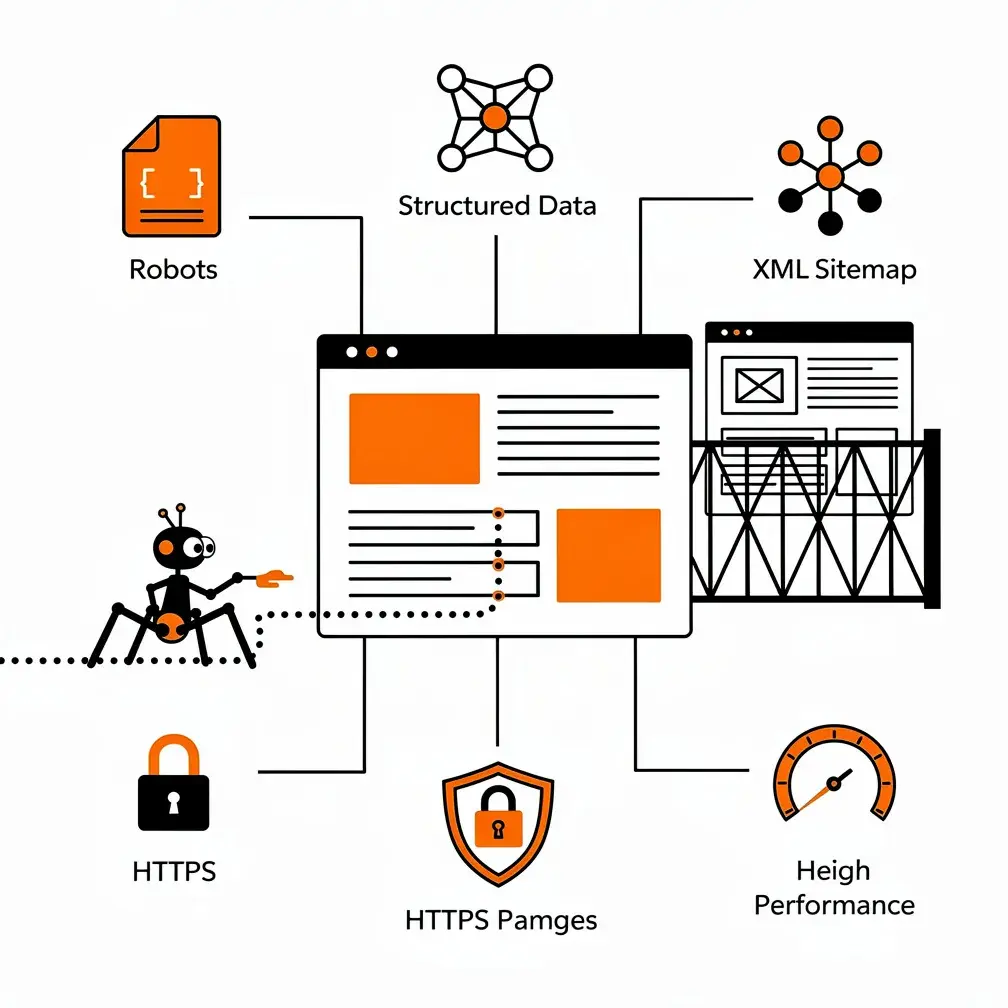
Avant que les moteurs d’intelligence artificielle puissent lire et référencer votre contenu, ils doivent pouvoir le trouver. Cela place les fondamentaux du référencement technique traditionnel au cœur de la préparation de votre site pour la recherche par intelligence artificielle. Nous parlons d’options d’indexation, de configuration du fichier robots.txt, de cartes de site XML, d’HTTPS et d’optimisation de performance. Examinons chacune d’elles.
Activer l’indexation et configurer Robots.txt
Tout d'abord, assurez-vous que votre site WordPress permet aux moteurs de recherche de l'indexer. Dans votre tableau de bord WordPress, allez à “ Paramètres ” > « Lecture » et assurez-vous que « Désactiver l'indexation des moteurs de recherche dans ce site » soit désactivé. Si cette case est cochée, ni Google ni les robots d'exploration automatique n'indexeront votre contenu.
Ensuite, configurez votre fichier robots.txt pour indiquer aux robots quelles parties de votre site doivent être indexées et lesquelles doivent être ignorées. Des plugins SEO comme All in One SEO et Yoast SEO proposent des outils pour modifier le fichier robots.txt directement depuis votre tableau de bord. Vous devez autoriser les robots à accéder aux contenus publics (articles, pages, images), tout en bloquant les pages d’administration, les écrans de connexion et les autres zones qui ne doivent pas être indexées.
Envoyer un Sitemap XML
Un sitemap XML est un fichier qui liste toutes les pages importantes de votre site, aidant ainsi les moteurs de recherche et les robots d’exploration à les découvrir de manière efficace. La plupart des plugins SEO génèrent automatiquement des sitemaps. Une fois générés, soumettez votre sitemap à Google Search Console et Bing Webmaster Tools. Cela garantit que les moteurs de recherche connaissent vos pages et peuvent les indexer rapidement, ce qui, à son tour, aide les systèmes d’intelligence artificielle qui dépendent des indices des moteurs de recherche à localiser le contenu pertinent.
Assurez l'utilisation du protocole HTTPS et optimisez les performances
La sécurité est importante pour les moteurs de recherche et les systèmes d’intelligence artificielle. Assurez-vous que votre site utilise le protocole HTTPS, comme indiqué par l’icône de cadenas dans la barre d’adresse du navigateur. Si vous n’êtes pas déjà connecté au protocole HTTPS, contactez votre fournisseur d’hébergement pour activer un certificat SSL.
La performance est également importante. Les sites de chargement lent frustrent les utilisateurs et peuvent entraîner des erreurs de crawl pour les robots. Compressez les images, activez le cache et choisissez un thème léger. Des outils comme NitroPack ou des plugins d’optimisation de performance peuvent vous aider. Lorsque votre site s’ouvre rapidement et de manière fiable, les visiteurs humains et les robots d’exploration ont une meilleure expérience, ce qui améliore votre visibilité et réduit le risque d’erreurs dans les réponses générées par l’IA concernant votre entreprise.
Implémentation des données structurées Schema.org
Schema markup transforms human-readable content into machine-readable statements about entities, relationships, and attributes. It’s the language that helps AI engines understand what your content is actually about, who wrote it, and why they’re credible. WordPress SEO plugins like Yoast, All in One SEO, and Rank Math automate much of this markup for you, adding schema that describes your organization, location, services, authors, and articles.
For local businesses, LocalBusiness schema is essential. It specifies your name, address, phone number, opening hours, and service categories. For agencies and B2B companies, Organization and Service schema help define your brand and offerings. Person schema can connect content to specific authors, enhancing E-E-A-T signals—experience, expertise, authoritativeness, and trustworthiness—that AI systems use to assess source credibility.
Yoast SEO Premium, for example, aggregates your site’s structured data into a single, deduplicated graph, providing AI agents with a consolidated representation they can retrieve in a single request. This schema aggregation aligns with how modern AI crawlers operate, as they prefer to fetch a comprehensive graph of a site’s entities rather than crawling multiple pages independently. We’re also seeing GEO optimization techniques increasingly rely on robust schema to signal authority and relevance to generative AI models.
Présentation de LLMs.txt : Le robots.txt pour l’IA
As AI crawlers become more prevalent, a new mechanism called llms.txt has emerged as a way for site owners to guide how large language models discover and use their content. Think of llms.txt as robots.txt for AI engines. You create a file called llms.txt in your site’s root directory and populate it with your most important URLs—key guides, category pages, your About page, service pages—so that AI systems know which content best represents your site and should be prioritized for reference.
What Goes in an LLMs.txt File
Your llms.txt file is essentially a curated list of URLs you want AI assistants to focus on. For a WordPress agency, that might include your homepage, main service pages like “Web Design,” “WordPress Maintenance,” and “AI Search Optimization,” your blog’s pillar articles, and your contact or about page. You can also include metadata or notes about each URL if desired, though the core function is simply to list the pages.
WordPress plugins like LLMs.txt Generator and llms-txt plugins available on WordPress.com automate this process. These tools generate a basic llms.txt file for your pages, allow manual updates, and handle periodic automatic refreshes to keep the file current as you publish new content. Some advanced plugins also offer validated JSON-LD schemas, automated llms.txt feeds, and crawler telemetry for AI tools like ChatGPT and Gemini, so you can check whether AI crawlers are successfully reading your site and fix any issues with a single click.
Controlling AI Crawler Access With Bot Blockers
On the flip side, you may want to limit which AI crawlers can use your content for training their models. Yoast SEO includes a bot blocker feature that lets you choose which AI crawlers—such as GPTBot, CCBot, or Google-Extended—are allowed to access your content. This gives you control over whether your intellectual property is used to train AI systems without your explicit consent.
There’s a trade-off here. Blocking AI training may reduce the risk of your content being reproduced without attribution, but it could also diminish your visibility within AI-generated answers and reduce the likelihood of being recommended by chatbots. We advise clients to weigh their priorities: if you’re more concerned about IP protection, tighten access; if you’re focused on maximizing AI discovery, leave crawlers open but use llms.txt to guide them toward your best content.
Optimiser le contenu pour une découverte locale de l’IA
Local SEO and AI search intersect in interesting ways. While Google’s AI Overviews appear less frequently for location-intent queries—adding “near me” drops AI Overview prevalence from about 35% to 10%—AI assistants are still heavily used for local business research. More than half of US consumers now use AI tools to find local businesses, and AI answers often appear at the top of search results even when traditional map packs are present.
Ensure Consistent NAP Across All Platforms
Your NAP—name, address, phone number—must be consistent across your WordPress site, Google Business Profile, social media accounts, and any other directories or platforms where you’re listed. Inconsistent information confuses AI engines and increases the likelihood of errors in AI-generated answers. If your site says you’re open Monday to Friday 9-5, but your Google Business Profile says you’re closed Wednesdays, AI assistants may combine those signals incorrectly and tell users you’re unavailable when you’re actually open.
We recommend auditing all your online profiles regularly—at least quarterly—to catch and correct discrepancies. Tools like Moz Local or BrightLocal can help automate this, but even a manual check of your top five listings (Google Business, Bing Places, Facebook, Yelp, and your own website) can prevent most problems. For more on this, see our guide on mastering NAP and local SEO.
Create Dedicated Pages for Each Location or Service Area
If you serve multiple cities or regions, build a dedicated page for each location with clear headings, concise answers to common questions, and LocalBusiness schema that specifies address, hours, service categories, and geo-coordinates. For instance, a page titled “WordPress Web Design Services in Toronto” should immediately answer “What WordPress services do you offer in Toronto?” followed by details on design, maintenance, support, and how to get started.
Use FAQ blocks on these pages to address queries often posed to AI assistants, such as “Do you offer WordPress maintenance in Toronto?” or “What are your support hours for Canadian clients?” By providing explicit, structured answers, you make it easy for AI tools to quote your information accurately.
The Verification Loop: Preparing for Multi-Channel Discovery
One striking feature of AI-driven local discovery is the “verification loop.” Consumers now traverse multiple platforms to cross-check information before taking action. A user might ask ChatGPT for a short list of WordPress agencies in Vancouver, then pivot to Google Maps to see locations and ratings, and finally check Instagram or Facebook to preview the look and feel of the agency before reaching out.
This means AI search readiness is necessary but not sufficient. Your WordPress site must be structured so AI tools can confidently recommend you, but your underlying content, social presence, and review ecosystem must substantiate those recommendations when users investigate further. We can’t assume a linear funnel from search result to landing page to conversion anymore. The first touchpoint might be an AI-generated answer that mentions your brand, followed by several indirect encounters across maps, review sites, and social feeds before the user ever visits your site. If you want to learn more about tracking these multi-channel interactions, check out our article on mastering WordPress analytics for growth.
Plugins et outils de SEO à l’intelligence artificielle pour WordPress
A growing ecosystem of AI-aware SEO plugins and platforms now exists to help WordPress agencies and businesses optimize for both traditional search and AI engines. Let’s look at some of the leading options and what they offer.
All in One SEO (AIOSEO)
AIOSEO markets itself as the original AI SEO plugin for WordPress. It covers traditional SEO features like schema markup, XML sitemaps, local SEO support, keyword tracking, internal linking automation, redirects, and SEO audits. For AI search, AIOSEO generates llms.txt files so that AI engines like ChatGPT, Google AI Overviews, and Perplexity can discover your content and surface it in answers. It also provides AI Insights reports that track how your brand and content appear across AI search platforms, giving you visibility into whether you’re being cited or recommended.
Yoast SEO
Yoast SEO integrates AI tools directly within its editor, offering AI-generated SEO titles and meta descriptions, suggestions for keyphrase placement, automatic summaries you can place in posts, and content planning features that propose site-specific ideas. Yoast also includes llms.txt management and a bot blocker to control which AI crawlers can access your content. Its schema output covers a wide range of types, including Person, Organization, LocalBusiness, Service, and more, and Yoast Premium aggregates these into a unified graph that AI engines can consume efficiently.
Rank Math AI
Rank Math AI offers a complete AI-powered SEO suite focused on both traditional rankings and generative engine optimization. Its AI Visibility tools track brand mentions and visibility across ChatGPT and Gemini, while AI Link Genius analyzes your content and suggests internal links to improve discoverability and semantic coverage. Rank Math emphasizes that SEO helps pages rank in traditional search, while GEO helps brands get cited inside AI-generated answers, and most sites now benefit from optimizing for both.
WP SEO AI
WP SEO AI positions itself as a WordPress-native search visibility platform that automates the entire SEO workflow—researching, creating, publishing, analyzing, and optimizing content—across organic AI search, traditional search, and paid search. It generates contextual content designed to perform in both environments, identifies the keywords and questions buyers are actually asking in Google and AI engines, and monitors visibility across Google, ChatGPT, Gemini, Perplexity, and more. Its messaging is direct: being on page one of Google is no longer sufficient because people rarely click ten links anymore. If your business isn’t in the AI’s answer, you effectively don’t exist for that buyer.
Polymetric AI Search Optimizer
Polymetric focuses specifically on GEO and AEO for chatbots and AI Overviews. It adds a panel to the WordPress block editor that restructures posts for AI readability without changing your voice or links. It reorganizes content into clear structures, key-takeaway summaries, and featured-snippet answer blocks—the formats AI systems tend to pull from—while preserving specifics and affiliate parameters. If you publish content frequently, Polymetric can help systematize the process of making each post AI-ready.

Mesurer le succès dans l’ère de la recherche IA
As zero-click rates climb, we need to rethink how we measure and communicate the value of our work. Traditional metrics like organic click-through and on-site conversion remain important, but they no longer capture the full picture of how a brand is discovered and evaluated. AI-aware SEO tools introduce new measurement paradigms: tracking how brands and content appear across AI search engines, including impressions within AI answers, citations of specific pages, and mentions of brand names in chatbot responses.
Impressions, Citations, and Brand Mentions
AIOSEO’s AI Insights and Rank Math AI’s visibility tools let you see whether your brand appears in AI-generated answers and which pages are being cited. WP SEO AI monitors visibility across multiple platforms, showing you where you’re present and where you’re absent. For example, you might discover that your blog post on skyrocketing SEO with WordPress blogging is cited by ChatGPT when users ask “How do I optimize WordPress blog posts for AI search?” even if those users don’t immediately click through to your site.
These AI visibility metrics help demonstrate impact in environments where clicks are scarce but exposure remains valuable. A local restaurant might see fewer direct clicks from Google Search, but if its name appears in top AI assistant recommendations for “best brunch in Austin” and its WordPress site is cited in AI Overviews answering “Is Restaurant X open on Sundays?”, that’s measurable value. For B2B agencies, being referenced by ChatGPT in responses to queries from business owners is a form of thought leadership and brand awareness that doesn’t show up in traditional analytics but still drives inquiries and conversions over time.
Integrating AI Metrics Into Client Reporting
We recommend incorporating AI visibility metrics into your standard client reports alongside traditional SEO KPIs. Create a section that shows AI impressions, brand mentions, and citations across ChatGPT, Gemini, Perplexity, and Google AI Overviews. Include screenshots of AI-generated answers that reference the client’s content. Explain that while clicks may be down industry-wide due to zero-click behavior, the client’s brand is appearing in AI-driven discovery experiences that influence purchase decisions and build authority.
This contextualization is critical. Clients who only see declining click numbers will assume the strategy is failing. Clients who see declining clicks but rising AI citations, stable or growing brand impressions, and positive mentions in AI answers will understand that the landscape has shifted and that you’re adapting to it successfully. For more ideas on how to frame these conversations, see our piece on WordPress and modern marketing teams.
Éduquer les clients sur la nouvelle réalité
Many business owners still conceptualize SEO in terms of “getting on the first page of Google” and may not fully appreciate the implications of AI Overviews, chatbots, and zero-click behavior. We have an educational role to play. We must explain how search behavior has changed, using accessible statistics and examples, and clarify what AI search readiness entails in practical terms.
Present the Data
Share the numbers: 68% of US searches and nearly two-thirds of Canadian searches now end without a click. Only about 231 of every 1,000 US searches result in a visit to the open web, and in Canada it’s roughly 268 per 1,000. More than half of consumers use AI tools to research local businesses, with especially high adoption among younger and higher-income segments. These statistics make the case that optimizing only for traditional clicks is no longer adequate.
Use Live Demonstrations
During strategy sessions, perform live queries. Ask ChatGPT or Gemini “What are the top WordPress agencies in Toronto?” and show whether the client appears in the answer and which sources the AI cites. Query “How do I prepare my WordPress site for AI search?” and examine whether your own blog posts are referenced. These demonstrations help clients grasp how AI assistants function as discovery channels and why structured, authoritative content matters. You can also explore emerging Tendances WordPress 2026 to show clients how the industry is evolving.
Outline the Steps
From there, outline the technical, editorial, and analytical steps required to ready the client’s WordPress site for AI search. Frame these efforts as investments in long-term visibility in a landscape where clicks are scarce but AI-driven impressions are abundant. Emphasize that AI search readiness is not a one-time project but an ongoing discipline, much like traditional SEO, requiring regular content updates, schema maintenance, and monitoring of AI outputs.
Aspects éthiques et de confiance
AI search raises ethical and legal questions around data usage, consent, and misinformation. Tools like Yoast SEO’s bot blocker let site owners control which AI crawlers can use their content for training, reflecting growing concerns about unconsented data harvesting. LLMs.txt governance provides mechanisms for specifying how AI models should interact with site content, though enforceability and adoption vary across AI providers.
Balancing Visibility and IP Protection
We must advise clients on the trade-offs. Blocking AI training may reduce the risk of content being reproduced without attribution but could also diminish visibility within AI-generated answers and reduce the likelihood of being recommended by chatbots. Each client will have different priorities depending on their industry, competitive landscape, and comfort level with AI usage of their content.
Monitoring and Correcting AI-Generated Misinformation
Trust issues extend beyond training to the accuracy of AI-generated responses. Two-thirds of AI users have received wrong information about a local business, and 30% experienced real problems as a result. This highlights the reputational risks that AI misrepresentation can pose. We recommend proactive monitoring of AI outputs related to your clients. Periodically query chatbots and AI search modes to check for inaccuracies, and where possible use feedback mechanisms to correct errors.
You may also need to update on-site content to clarify points that AI systems consistently misunderstand. Add explicit statements, FAQs, or schema annotations that disambiguate similar names, explain service limitations, or highlight recent changes. By treating AI search not only as a marketing channel but also as a potential source of misinformation that must be managed, you can help protect clients’ reputations while still leveraging AI tools for discovery and engagement.
Intégrer les pratiques IA dans le workflow de votre agence
To make AI search readiness sustainable, we need to embed GEO and AEO practices into our design and development workflows, not treat them as one-off SEO add-ons. This begins with template design. Standardize page layouts that include prominent answer summaries near the top, structured headings reflecting likely user questions, FAQ blocks addressing common concerns, and schema-rich components for organizations, services, and locations.
Development Standards
Development teams should ensure templates output clean HTML, fast-loading assets, and consistent structured data. Configure robots.txt and llms.txt correctly during initial setup and verify that AI crawlers can access key pages. Build schema into page templates so it’s automatically applied to new content rather than requiring manual intervention for each post or page.
Maintenance and Monitoring
Maintenance and support teams play a complementary role. Because AI engines periodically retrain and update their indexes, critical content must stay current, especially information that AI assistants often use to answer questions about business status, pricing, or service availability. Schedule regular reviews of FAQs, business hour pages, and service descriptions. Update promptly following any changes. Monitor how AI tools represent the client’s business using AI visibility tools and address inaccuracies quickly.
Support teams may also need to configure bot blockers and llms.txt rules in response to client preferences about AI training and referencing, balancing visibility goals with concerns about data use. By integrating these tasks into standard maintenance contracts, agencies across the US and Canada can offer clients ongoing assurance that their WordPress sites remain aligned with evolving AI search environments.
Positionner votre agence pour une leadership en recherche IA
For WordPress agencies in the US and Canada, AI search readiness is both a challenge and an opportunity. Agencies that embrace this shift—investing in GEO and AEO practices, adopting AI-aware tooling, and educating clients about the new realities of search—are well positioned to help their clients remain visible and trusted in an increasingly AI-mediated web. More than that, they differentiate themselves as strategic partners who understand where digital discovery is headed and how to navigate it successfully.
We’ve found that clients who grasp the zero-click reality and the role of AI assistants in discovery are more willing to invest in comprehensive content strategies, robust schema implementation, and ongoing monitoring. They understand that the goal is no longer just to rank on page one but to be the source AI engines quote when users ask questions about their industry, location, or service area. That’s a fundamentally different value proposition from traditional SEO, and it requires a fundamentally different approach to WordPress design, development, and maintenance.
The overarching message is clear: being ready for AI search means more than installing a plugin or adding a few FAQs. It demands a holistic shift in how sites are architected, written, governed, and evaluated, with AI assistants and zero-click answer environments treated as primary discovery channels alongside traditional search and social platforms. Agencies that make this shift now will lead the next decade of digital strategy in North America, while those that cling to outdated models will watch their clients’ visibility erode as AI continues its rapid takeover of search behavior.
Foire aux questions
How is zero-click search affecting WordPress website traffic?
Zero-click search means users increasingly get answers directly in Google or through AI assistants without visiting a website. The blog explains that this makes traditional rankings and click-through rates less reliable as success measures. A page can still rank highly yet receive fewer visits if an AI Overview summarizes its content. WordPress businesses should therefore optimize not only for rankings, but also for visibility, citations, and accurate mentions in AI-generated answers.
What makes WordPress content easier for AI engines to understand?
AI engines favor content that provides direct, well-structured answers. Lead with the main takeaway under each heading, use headings that reflect real questions, and avoid burying important information beneath long introductions. Focused FAQ sections are especially useful because each question-and-answer pair can be extracted easily. Clear writing helps both AI systems and human readers quickly understand your services, expertise, locations, and answers to common customer concerns.
Which technical WordPress settings support AI search visibility?
Start by confirming that WordPress indexing is enabled under Settings > Reading and that robots.txt does not block important public pages. Generate and submit an XML sitemap, use HTTPS, and improve loading speed through image compression, caching, and lightweight themes. Add relevant Schema.org markup, such as Organization, LocalBusiness, Service, Person, or Article schema. These foundations help crawlers discover, interpret, and assess your content more reliably.
What is llms.txt, and how can it help a WordPress site?
llms.txt is an emerging Markdown-based convention that provides AI assistants with a curated map of a website’s most important content. A WordPress site might list its homepage, service pages, location pages, About page, and authoritative guides. It does not replace indexing, robots.txt, or an XML sitemap, but it can make priority content easier for AI tools to identify. Plugins can generate and refresh the file automatically as the site changes.
How should local businesses prepare for AI-driven recommendations?
Keep your business name, address, phone number, hours, services, and location details consistent across your website, Google Business Profile, social accounts, and directories. Create dedicated pages for each location or service area, using clear answers and LocalBusiness schema. Also monitor AI-generated recommendations because inaccurate details can damage trust. Customers often verify AI suggestions through maps, reviews, and social media, so every channel should support the same accurate information.